


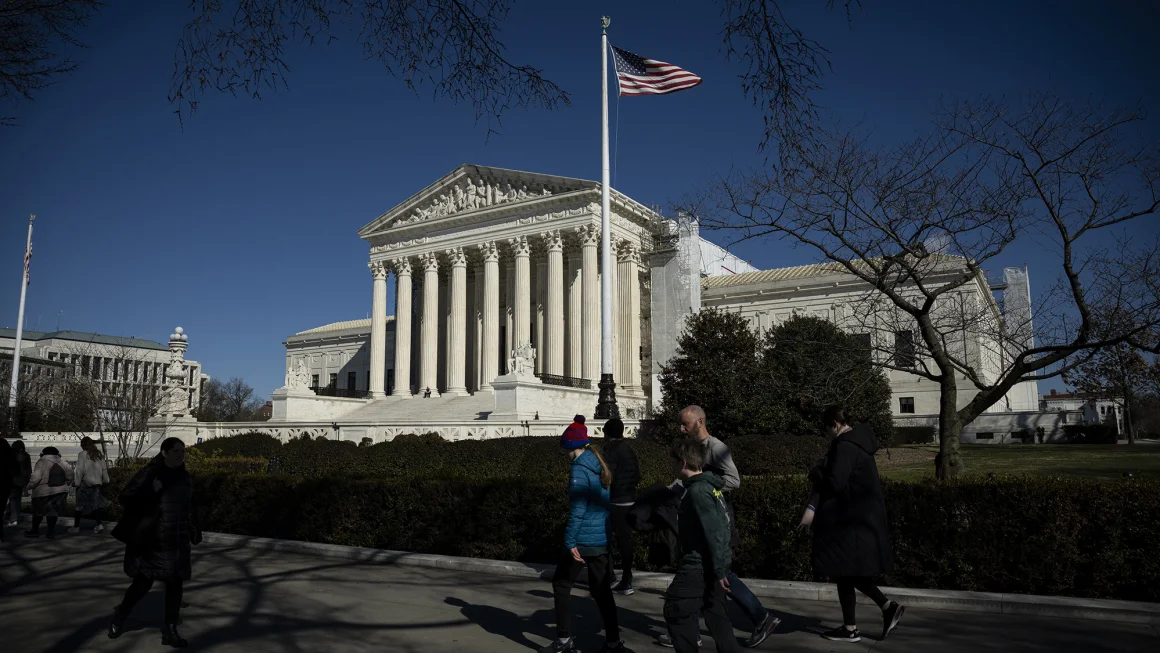
The US Supreme Court is set to make a pivotal decision about what Americans can see on social media as it takes up two cases this week that could transform the internet as we know it.
On Monday, the court will consider arguments on whether to give Texas and Florida significantly more control over social media platforms and their content, highlighting the central role that those services now play in modern American life.
The crux of the matter: Can these platforms decide for themselves what content goes on their sites — and what can be removed?
The states want to keep Facebook, TikTok, YouTube and others from removing users’ posts — potentially even ones that promote hate speech or eating disorders, lie to voters about elections and more. But that push is running up against the First Amendment.
A ruling for the states could even change how Americans hear about the upcoming 2024 elections everywhere from Instagram to X and beyond.
Texas and Florida officials argue their laws imposing restrictions on content moderation are constitutional because they seek to regulate social media platforms’ business behavior, not their speech. But opponents including NetChoice, an industry group suing to block both laws, say they infringe on the platforms’ own First Amendment rights and that their breadth could lead to vast unintended consequences.
For example, a group of political scientists told the court the laws effectively require platforms to treat “dangerous and violent election-related speech” the same as innocuous speech and don’t give social media platforms enough freedom to moderate threats against election officials.
Is restricting content moderation constitutional?
Monday’s Supreme Court showdown in NetChoice v. Paxton and Moody v. NetChoice will determine whether states can forbid social media companies from blocking or removing user content that goes against platform rules.
The state laws at issue also allow individuals to sue tech companies for alleged violations.
The Florida and Texas laws are broadly written, but officials from both states say the laws will keep social media sites from unfairly silencing conservatives. Social media platforms have insisted for years that they don’t discriminate against right-wing speech.
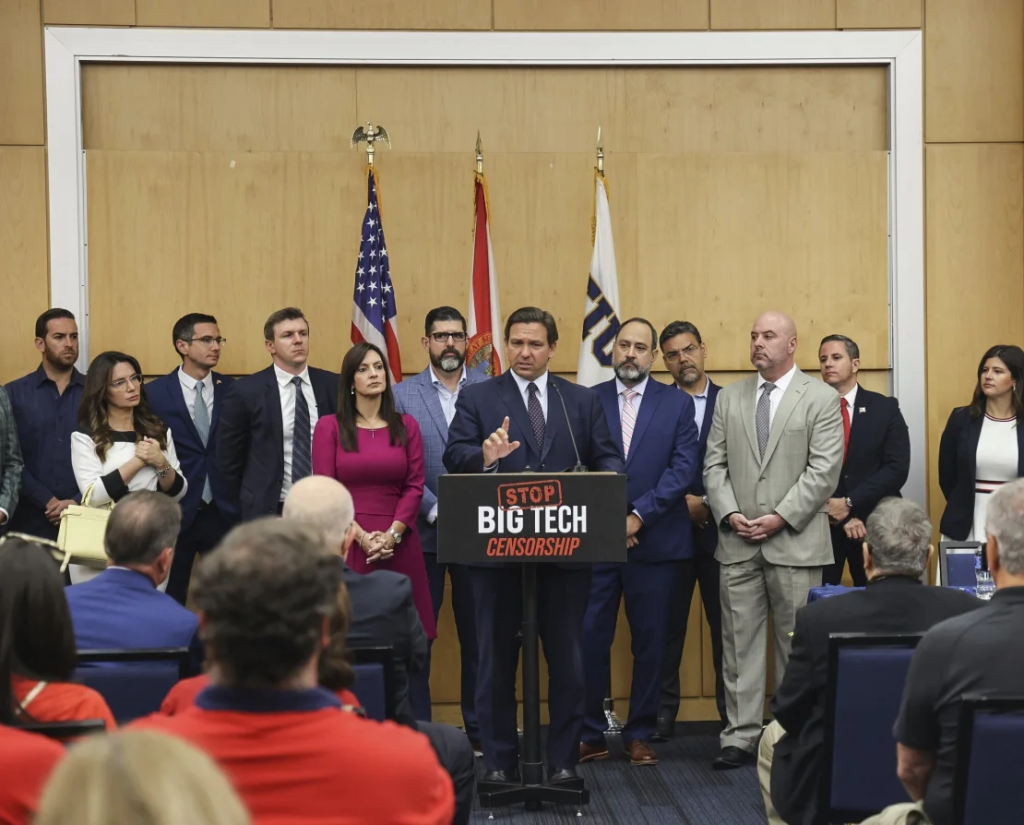
Signed in 2021 by Gov. Ron DeSantis, Florida’s SB 7072 prohibits tech platforms from suspending or banning the accounts of political candidates in the state, with violations carrying steep possible fines of up to $250,000 per day. It also allows individual social media users to sue platforms if they believe they have been unfairly censored or “deplatformed.”
The Texas law, signed in 2021 by Gov. Greg Abbott, makes it illegal for any large social media platform to “block, ban, remove, deplatform, demonetize, de-boost, restrict, deny equal access or visibility to, or otherwise discriminate against expression.” Like the Florida law, Texas’ HB 20 permits individual internet users to sue social media platforms for alleged violations.
Social media platforms are now so important as a new public square, the states say, that we need new laws to make them follow free speech ideals, even though the First Amendment applies to governments and not private businesses.
The tech industry argues that the laws violate the companies’ own First Amendment rights to decide what speech to welcome on their private platforms.
Lower courts have split on the dispute. In the case involving the Texas law, the US 5th Circuit Court of Appeals held in 2022 that social media platforms do not have “a freewheeling First Amendment right to censor what people say.”
But the 11th Circuit Court of Appeals ruled the same year that Florida’s “restrictions are substantially likely to violate the First Amendment,” because governments can’t make social media platforms “speak,” even if it’s through posts by third parties.
Now, the Supreme Court could settle that debate once and for all.
Are tech companies more like publishers or public utilities?
The NetChoice cases reflect a deep divide in how many people see social media. Supporters of the state laws say social media should allow all speech, without judging its message. Opponents say the platforms have the right to decide what content they display.
More than a dozen states led by Republican attorneys general have called on the Supreme Court to back Texas’ and Florida’s legislation, arguing that social media companies act like utilities such as the phone network and should be regulated the same way.
Former President Donald Trump, in his own brief to the court, argued that social media platforms “act like airlines carrying passengers, telegraph companies transmitting messages, or railroads carrying freight.”
But social media companies are more like newspapers and cable companies, which can freely choose to curate what they show, and they enjoy the same constitutional protections against government speech mandates as those industries, the Biden administration wrote in a filing last year.
If enforced, the state laws would lead to “absurd results” because they would give scammers, trolls and hateful extremists an excuse to overwhelm websites with censorship allegations, wrote the Electronic Frontier Foundation (EFF), a consumer advocacy group.
EFF called the Florida law “a major setback to efforts to combat spam, since every action to limit the spread of spam messages might be considered an impermissible ‘shadow ban’ under the law.”
“Allowing social media sites to be free from government interference in their content moderation ultimately benefits internet users,” David Greene, senior staff attorney and civil liberties director at EFF, told CNN. “When platforms have First Amendment rights to curate the user-generated content they publish, they can create distinct forums that accommodate diverse viewpoints, interests, and beliefs.”

The court’s decision in the NetChoice cases could also reach far beyond what appears on individual sites.
A ruling for Texas and Florida could reshape a longstanding precedent barring governments from “compelling speech” — that is, forcing private individuals to say something against their will. For example, a 1974 case determined that a Florida law requiring newspapers to publish a political candidate’s speech violated the First Amendment.
Forcing social media companies to publish all speech, even if the platforms would rather remove it, would be a form of compelled speech and a dramatic and ominous shift in First Amendment law, critics of the Texas and Florida laws say.
It could lead to precisely the sort of government interference the First Amendment was meant to guard against, according to the Reporters Committee for Freedom of the Press.
“The larger the platform the state seeks to control, the greater will be the state’s influence on public and political discourse,” that group wrote in a brief.
— CutC by cnn.com
