



Ziwei can still remember the months she spent huddling alone in a tiny shoebox apartment in Taipei.
There was no window in the 10-sq-m studio, just a small vent near the ceiling. It perpetually stank of sewage, even after she stuffed her shower drain with plastic bags. And the walls were painted in just the oddest shade of orange.
“With no windows, I felt so sad,” the 32-year-old recalled. “I would stay out really late every night, and I would come home only to sleep.”
But it was all she could afford in 2019 after breaking up with her boyfriend and moving out. Though she was a civil servant – considered to be a good job – her monthly pay was NT$40,000 ($1,285; £1,011) at the time, well below the national average.
Low wages and housing will be on the minds of Ziwei and six million Taiwanese voters under the age of 40 on Saturday, when they choose their president and parliament. As it does at every election, the question of China's claims on Taiwan and how the island should respond to Beijing's threats looms large. But this time voters are more concerned about the economy.
A recent survey of 15,000 Taiwanese by Commonwealth Magazine saw most stating that economic development should be their next president's top priority, over national security and cross-strait relations. It was especially crucial for respondents aged between 20 and 39.
After eight years in power, the Democratic Progressive Party (DPP) is coming under fire for failing to adequately improve people's lives, especially younger Taiwanese.
Rising house prices and rentals, stagnating incomes, a significant youth unemployment rate, and an annual GDP growth hovering around 2% have worried many. More than a third of low-wage workers are aged below 30, according to an analysis provided to the BBC by labour expert Lee Chien-hung from the Chinese Culture University.
It's given rise to social phenomenon such as the “beipiao”, youths from poorer parts of Taiwan seeking better jobs in the capital while grappling with rising rents. There's also the “xiegang”, young workers juggling multiple jobs to earn a decent wage, and the “yueguangzu”, those who live paycheck to paycheck with no savings.
Kaili, a friend of Ziwei's, is a “beipiao” from the southern city of Chiayi resigned to a lifetime of renting in Taipei. When it comes to buying her own home “I've given up hope”, said the 37-year-old, who works in documentary films.
“I can't see the reason why I should buy. My salary is quite low. I don't think I can afford to put down a deposit on a home, not now, not even in ten years' time.”
Ziwei can still remember the months she spent huddling alone in a tiny shoebox apartment in Taipei.
There was no window in the 10-sq-m studio, just a small vent near the ceiling. It perpetually stank of sewage, even after she stuffed her shower drain with plastic bags. And the walls were painted in just the oddest shade of orange.
“With no windows, I felt so sad,” the 32-year-old recalled. “I would stay out really late every night, and I would come home only to sleep.”
But it was all she could afford in 2019 after breaking up with her boyfriend and moving out. Though she was a civil servant – considered to be a good job – her monthly pay was NT$40,000 ($1,285; £1,011) at the time, well below the national average.
Low wages and housing will be on the minds of Ziwei and six million Taiwanese voters under the age of 40 on Saturday, when they choose their president and parliament. As it does at every election, the question of China's claims on Taiwan and how the island should respond to Beijing's threats looms large. But this time voters are more concerned about the economy.
A recent survey of 15,000 Taiwanese by Commonwealth Magazine saw most stating that economic development should be their next president's top priority, over national security and cross-strait relations. It was especially crucial for respondents aged between 20 and 39.
After eight years in power, the Democratic Progressive Party (DPP) is coming under fire for failing to adequately improve people's lives, especially younger Taiwanese.
Rising house prices and rentals, stagnating incomes, a significant youth unemployment rate, and an annual GDP growth hovering around 2% have worried many. More than a third of low-wage workers are aged below 30, according to an analysis provided to the BBC by labour expert Lee Chien-hung from the Chinese Culture University.
It's given rise to social phenomenon such as the “beipiao”, youths from poorer parts of Taiwan seeking better jobs in the capital while grappling with rising rents. There's also the “xiegang”, young workers juggling multiple jobs to earn a decent wage, and the “yueguangzu”, those who live paycheck to paycheck with no savings.
Kaili, a friend of Ziwei's, is a “beipiao” from the southern city of Chiayi resigned to a lifetime of renting in Taipei. When it comes to buying her own home “I've given up hope”, said the 37-year-old, who works in documentary films.
“I can't see the reason why I should buy. My salary is quite low. I don't think I can afford to put down a deposit on a home, not now, not even in ten years' time.”
On a chilly Wednesday night in the port city of Keelung, a crowd made up mostly of young families and couples gathered by the waterfront for a TPP rally. They cheered as speakers urged them to “smash the blue and green”, a reference to the KMT and DPP's party colours, and waved placards with one of Mr Ko's campaign slogans, “Keep Promise”.
Among them was Harrison Wu, a 25-year-old engineer. He voted for the DPP in the last election, but his hopes for the party have curdled into disappointment.
“[President] Tsai Ing-wen has been too soft,” he said, before launching into a litany of complaints ranging from exorbitant housing prices and low wages to party corruption scandals.
“They had control of the legislature for eight years and didn't get anything done. Now they are asking us to vote in a DPP majority again, but what's the point?”
The DPP is aware that young people are losing faith in them. It has promised to build more affordable housing, raise the minimum wage, and invest in upskilling younger workers so they can get better jobs.
It's also appealing to millennials for their support. Its latest campaign ad is dedicated to the Sunflower Movement generation that organised anti-China protests a decade ago, paving the way for the DPP to kick the KMT out of government in 2016.
With a melancholic soundtrack, set to shots of people moving backwards and references to the KMT, the ad warns youths that Taiwan's progress achieved under the DPP could be rolled back if they lose power.
“You feel a bit exhausted, you don't want to speak out because it's too troublesome,” a young man's voiceover says soothingly. “But the very thing you didn't want is now returning.”
“You once stood up for your beliefs, once saw the vote in your hands as the most important thing… Only you can make the choice so that Taiwan can be our Taiwan.”
Bursting bubble
For decades successive Taiwanese governments have discussed how to solve issues such as low wages “but no matter which party [is in power] it still hasn't been accomplished,” said Dr Lee, the labour expert.
“The government must dutifully face society's problems and stop its empty talk.”
Lev Nachman, a political scientist at the National Chengchi University, said this election all three parties have offered similar proposals to help young voters, but whoever wins must make solving economic issues their top priority. “It will be a bubble that will pop, if they do not.”
But in some ways that's already happening. Taiwan is seeing a brain drain as young people seek better prospects elsewhere. Migration data shows that, excluding the pandemic years, the number of Taiwanese working overseas has steadily increased in the past decade. Nearly half of them are aged under 40.
Ziwei is planning to stick around for now. She's found new love, and new digs.
These days she lives in a much bigger apartment in New Taipei City with her husband Wenjing, Kaili, and another friend. Thankfully there are windows, it doesn't stink, and the walls are painted an inoffensive white.
Do the housemates have hope for their future in Taiwan? Despite their worries, they all said yes.
“I think my life will get better. Well, it's definitely better now than when I was 20, I was much poorer then!” said Kaili with a laugh.
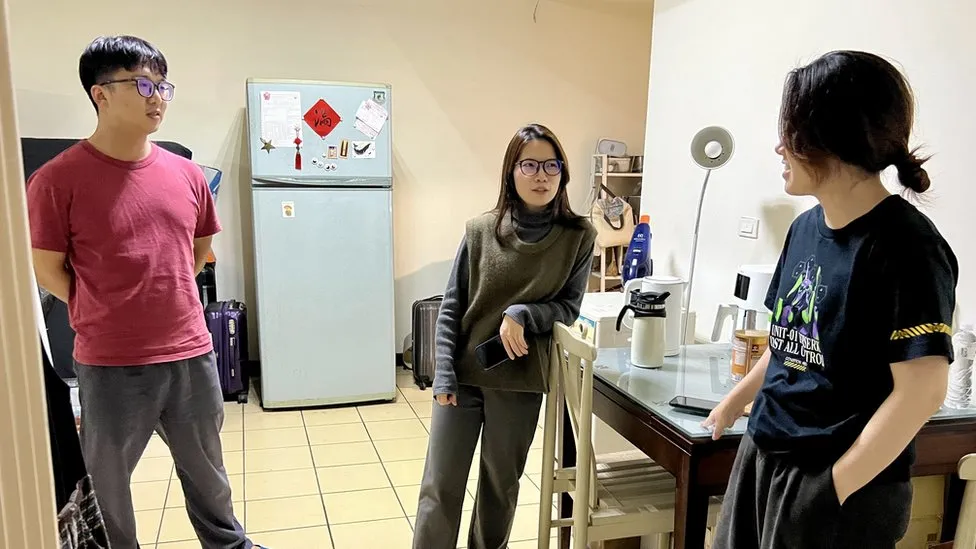
Ziwei and Wenjing said they recently managed to scrape together enough money to make the down payment on a new apartment. They're looking forward to having a place of their own so they can start a family. But they also wonder if they can afford to raise a child and pay for their home.
“If you don't have help from your own family, and rely on your own income, it can be quite hard,” said Wenjing, who works as a vet.
But they're determined to make it work. “We are saving up and cutting down our expenses. We share the same values, we're willing to work hard for a common goal,” said Ziwei.
“So when it comes to my future, I feel things will get better. And that's because I have a great partner by my side.”
— CutC by bbc.com
